[Florence] Santa Maria del Fiori Cathedral
The cathedral, designed by Filippo Brunelleschi, features a magnificent dome that dominates the city’s skyline. The dome, known as the Brunelleschi’s Dome, is a marvel of engineering and is considered a pioneering achievement in architecture.
- City council approved the design of Arnolfo di Cambio for the new church in 1294; The building of this vast project was to last 140 years

The Dome
The cathedral model depicted a massive inner dome, open at the top to admit light, like Rome’s Pantheon, partly supported by the inner dome, but enclosed in a thinner outer shell, to keep out the weather. It was to stand on an non-buttressed octagonal drum. The dome would need an internal defense against spreading (hoop stress), but none had yet been designed.
The building of such a masonry dome posed many technical problems. Filippo Brunelleschi looked to the great dome of the Pantheon in Rome for solutions. The dome of the Pantheon is a single shell of concrete, the formula for which had long since been forgotten.
Brunelleschi would have to build the dome out of brick, due to its light weight compared to stone and being easier to form, and with nothing under it during construction. To illustrate his proposed structural plan, he constructed a wooden and brick model with the help of Donatello and Nanni di Banco, a model which is still displayed in the Museo dell’Opera del Duomo. The model served as a guide for the craftsmen, but was intentionally incomplete, so as to ensure Brunelleschi’s control over the construction.

The decorations of the drum gallery by Baccio d’Agnolo were never finished after being disapproved by no one less than Michelangelo.

The unreinforced masonry that Brunelleschi used to construct the dome is weak in tension which leads to cracking when tensile stresses exceed the limited masonry tensile strength. The material is especially susceptible to damage from seismic loading due to its heterogeneity and many surfaces between different materials (stones to mortar connection).
In 1987 a second and more comprehensive digital system (which automatically collects data every six hours)
ART
*Dante Before the City of Florence* by Domenico di Michelino (1465)
This painting is especially interesting because it shows us, apart from scenes of the Divine Comedy, a view on Florence in 1465, a Florence such as Dante himself could not have seen in his time.
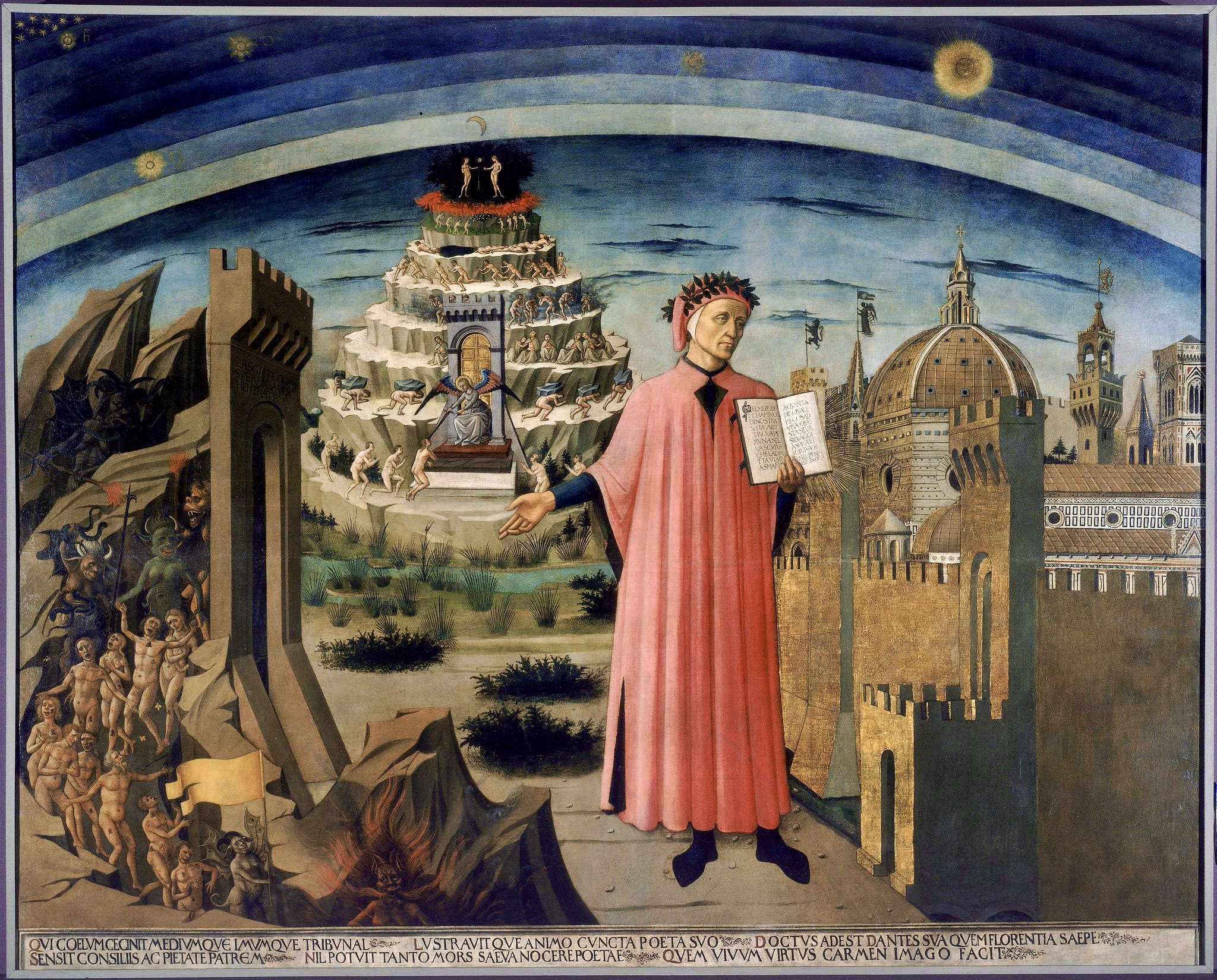
Dante motions with his free hand to where his spiritual journey takes him in the Divine Comedy. The gates of hell with the eternal flames are in the bottom left-hand corner, and written above the entrance is the famous line ‘Abandon all hope, ye who enter here’. The nine circles of hell are waiting below for the procession of sinners.
Then there is purgatory, a long, winding road around the mountain behind him in the centre of the painting; and, finally, meeting the archangel Gabriel in his armour, waving his sword in the air and weighing the souls at the gates of heaven. The garden of Eden flourishes with evergreen nature at the top.
Lastly, above Eden is the medieval make-up of the universe, pre-Galileo. We can just see the perfect concentric spheres, each one inhabited by a planet, and they are depicted here, recognisable by their symbolism.
The Last Judgement by Vasari and Zuccari
Although a great admirer of Michelangelo, Vasari also drew inspiration from the Last Judgement in the Sistine Chapel. The subjects were carefully matched up along the the dividing lines of rows and segments so that the theological pattern could be followed vertically and horizontally.
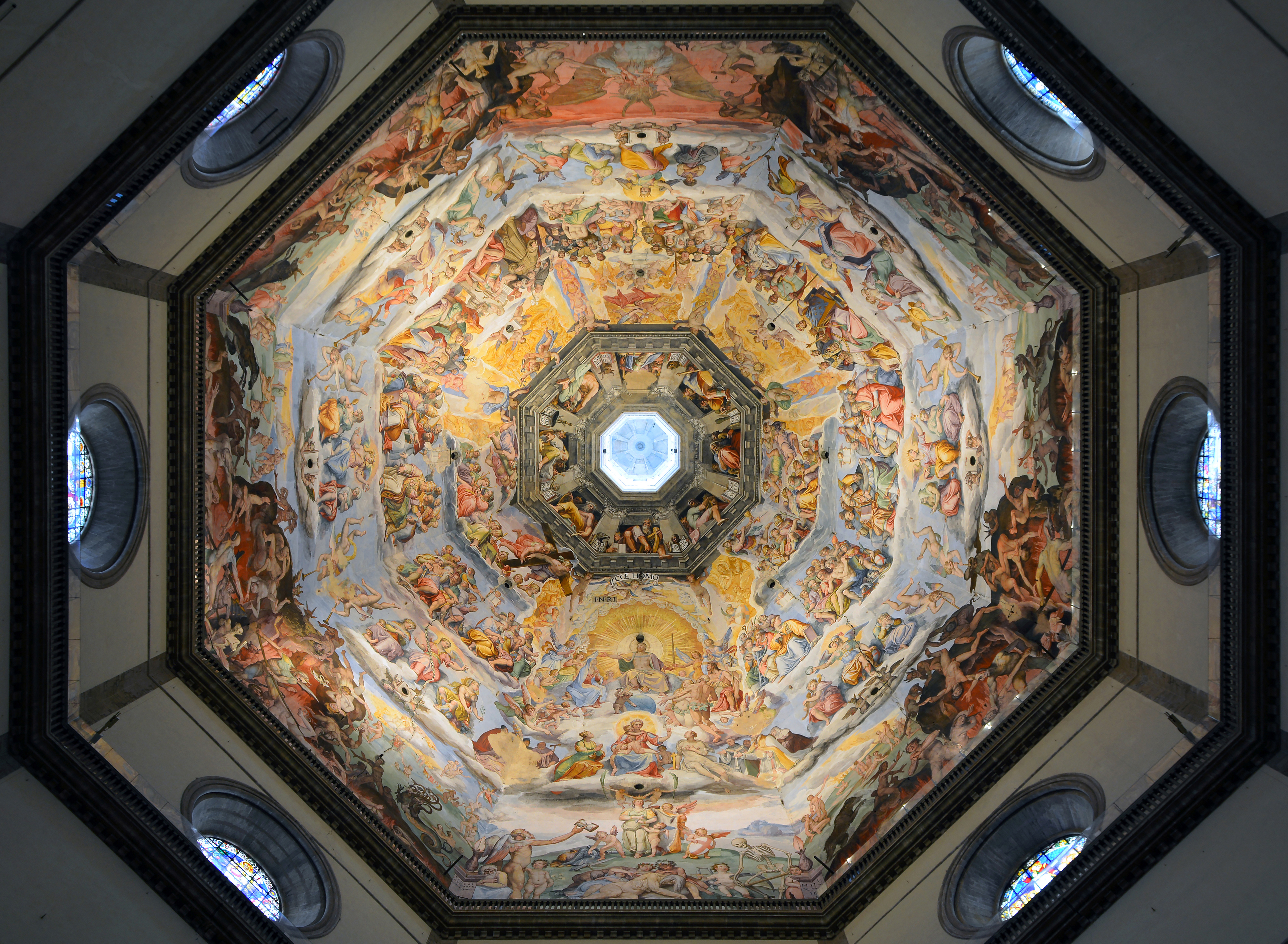
Starting from the false central lantern at the top of the dome, surrounded by 24 venerable old men from the Apocalypse, each segment is decorated with the four following themes: an angelic chorus with the instruments of the Passion, a series of Saints and Elect, a triad of figures representing a Gift from the Holy Ghost, and a region of Hell dominated by deadly Sin.
In the eastern segment, opposite the centrale nave, the four themes become three to make space for the great Christ in Glory placed between the Madonna and St. John above the three Theological Virtues (Faith, Hope, and Charity), and followed under by the allegorical figures of Time and the Triumphant Church.